Wednesday, April 8, 2015

A Greenstone for Me!


One of the prime objectives of our 4 day outing was to find a Greenstone that wanted to be mine, and Hokitika is the place to do that. Greenstone, or Pounamu, is a Nephrite Jade that is found only in the South Island of New Zealand. There are many forms of jade throughout the world, but only here can you find true Pounamu. In fact, the Maori name for the South Island is Te Wei Pounamu, which translates to The Land of the Greenstone Waters. The Arahura River just north of Hokitika is the center of Greenstone collection. 

To the Maori, the stones are sacred and it is believed that many have their own mana, or power. I think it's important to note that the government here has recognized the spiritual importance of Pounamu to the Maori and has granted them complete ownership and collection rights, unless it makes it to the sea where any rock collector is allowed to pick it up if they can carry it on their person. Anything that is too big to carry without assistance must be turned over. And that's provided you can actually recognize it to begin with. In it's raw form it looks milky or chalky, and many times you can't even tell that there is something green and precious inside.  It is a remarkably hard and durable stone, and has traditionally been carved into war clubs (mere), jewelry, fishhooks, and adze. The older the Pounamu, the more mana it holds. The more Pounamu one has been given, the more prestige they have. Given is the key word. Traditionally, Pounamu is always a gift or a spoil of war.


The legend of the creation of Pounamu goes something like this: Poutini was a giant water being that became infatuated with a beautiful Maori woman from the North Island, so he kidnapped her. Her husband, who was very strong and clever, was not pleased at all, and chased them down into the South Island. Poutini was frightened of the husband's determination and decided that if he could not have her, no one would. So he changed her into his image and laid her under the river's cold water. The pieces of Greenstone that break away and roll down the river are said to be her children, and as such have their own spirit. 


This is the piece that chose me. I say that it chose me, because I think it did. Of all the beautiful pieces in the shop we were in, I was drawn immediately to this one. It is called Kahurangi Pounamu, and it is carved in the shape of the Manaia. The Manaia has the head of a bird, the body of a man, and the tail of a fish. It is meant to represent the sky, earth, and sea, and the balance of the three. It is said to be a messenger between the living and the dead and is the carrier of supernatural powers. It is likened to a bird sitting on your shoulder to guard your spirit from evil, and to guide it where it is meant to go.


I don't know who else it's talking to, but it certainly speaks to me. And it must have spoken to Jeremy too to guide him to give me such a perfect gift.


Out and About in the Southern Alps: Wanaka to the Pancake Rocks


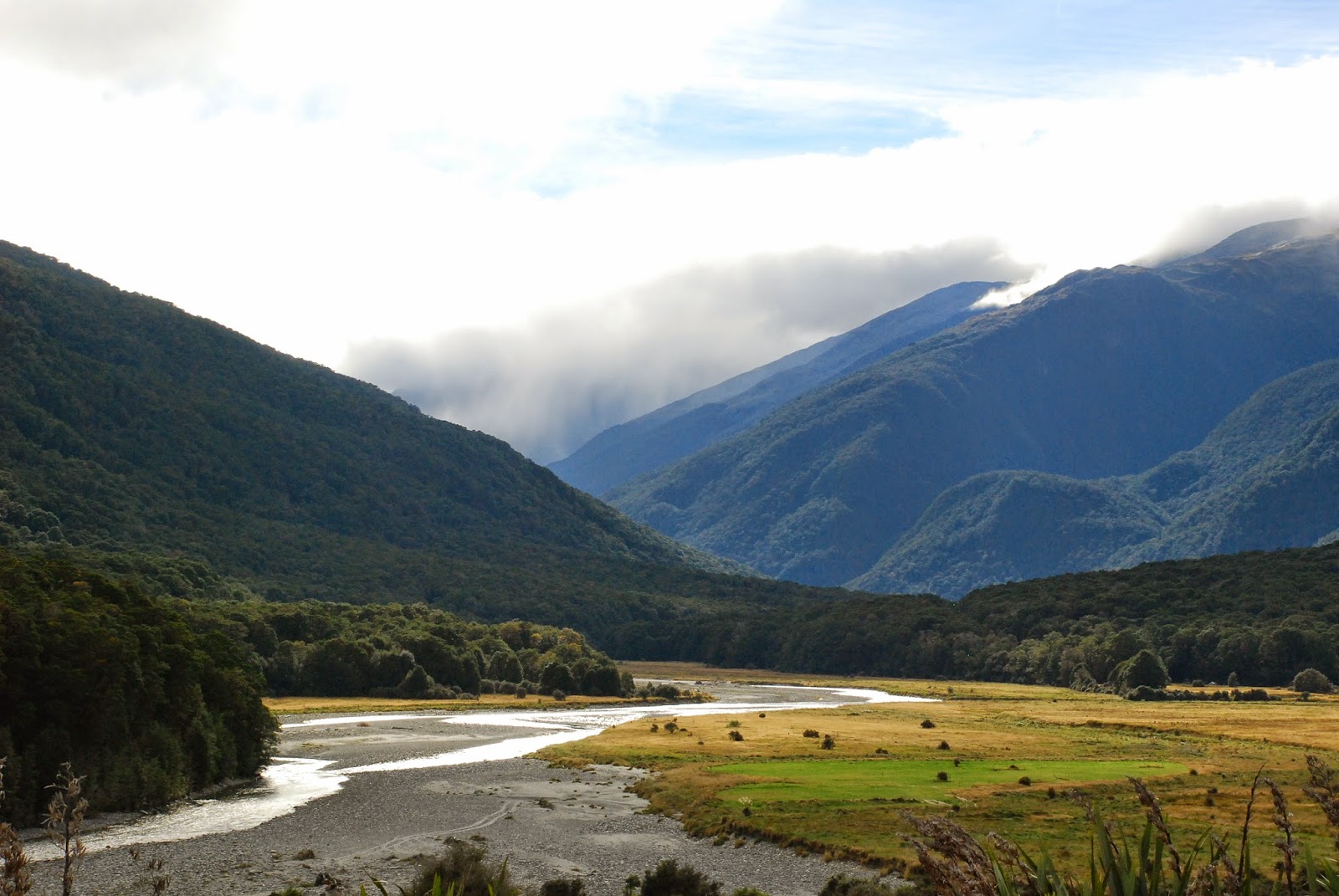
The girls are out of school for 2 weeks for Easter break, and Jeremy had a 5 day weekend last weekend, so we decided to head north into the alps, up the western coast all the way up north of Greymouth, then through Arthur's Pass, back down through some back roads to Geraldine, on to Lake Tekapo, and then home via Cromwell. There was a massive amount of scenery. Consequently, I shot over 1000 photos. Editing them has been no small feat, and I'll only show you my favs. Even then, I think I have about 4 blog posts just to try to order them. Here goes. This post will be pics of after we left the Cardrona, starting at a beautiful little lake town called Wanaka (above pic), and running through the glacier region, and up to the Pancake Rocks north of Greymouth. 


To put it into context, if you can make out that purple dot and line, that is the route we took. I'd say starting from our house, we traveled more than 2/3 of the way up the South Island.


View of the Rob Roy Glacier in Mt Aspiring National Park.


The bottom peaks of the Southern Alps. The Southern Alps are the backbone of the South Island, and pick up just about where the Fiordlands stop.


View of Lake Hawea.


These are the Blue Pools at the mouth of the Blue River.


It was absolutely teeming with trout.


In the fall, they travel up river from the lakes to feed.


The banks of the river are covered with cairns that people have left behind.


I think by now everyone knows how much I love the colors of the water here. It's wondrous and magical.


One of the dozens of lakes coming out of the glacier region.


Glimpse of the Fox Glacier, just before the clouds closed in on us.


The Gray River after a pretty heavy rain the day before. It is filled with so much rock flour that it is saturated and milky. It's so concentrated that it doesn't give off a color until it dilutes enough downstream.


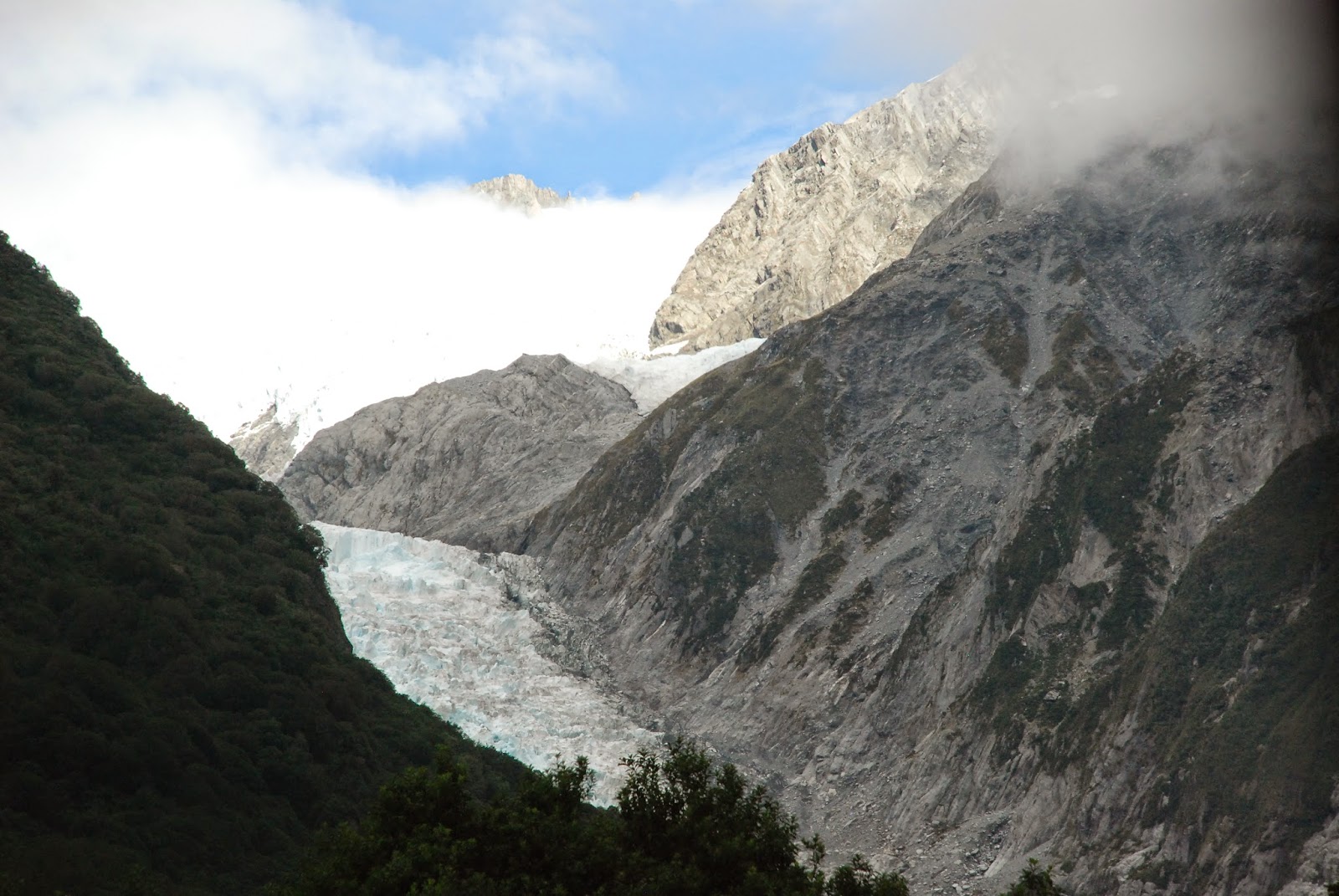
Super quick glimpse of the Franz Joseph glacier as the rain began to start again. It was so cool that there was a hole in the clouds right above the glacier. Everything else was socked in, and stayed that way the entire time we were there.


Old rail bridge at the Brunner Monument to the coal miners who have lost their lives.


Look! The actual end of the rainbow!


Pukeko in a field. These guys are rampant in the fields of the west coast. They are quite full of personality.


Heading deeper into the mountains. They begin to look like the Misty Mountains about now.


Hitting the ocean, the whole coast was socked in.


Slowly, the clouds started breaking up for us.


And then we got this. The west coast is famous for it's temperamental weather. But truly, our entire time here so far has been beyond gorgeous weather-wise, so we really can't complain too much.


Pancakes anyone?


The rock formations here have eroded in such a way that they are completely layered, and filled with tunnels. Some of them are more eroded than others, and many have already crumpled into the sea. 


They are absolutely so much grander than I had imagined.


Leading down into what would be a blow hole, had we been there at highest tide and when there is a westerly gust.


And another view, trying to take in the magnitude.


This was actually once a cavern, but most of the roof has collapsed into the water. Now it's technically a surge pool as there is a chasm that feeds it. There are several openings to the back reaches of the cave, and when the waves hit just right, they pound into the underground cavern's walls and you can feel the sound coming up through your feet even as you hear it. Kindof like a sonic boom. So very, very cool. Next up, I'll tell you about some Greenstone.


Tuesday, April 7, 2015

The Cardrona


On my list of things to see while we are in New Zealand was the Cardrona Hotel. Steeped in history, the Cardrona sits in the heart of the Cardrona Valley, as it has since 1863.


Traveling from Queenstown, we opted to take the Crown Range Road. Like many of the roads here, it is not for the faint of heart. Very narrow, little to no shoulder, and steep switch-backs definitely serve to keep your eyes open to the resplendent scenery.


There are many things about New Zealand, especially in Southland, that remind me of the early days of the American West. One example of that is that NZ has had it's very own series of gold rush action.  In the early 1860s, word spread that gold had been discovered in the Crown Range, and the town of Cardrona popped up to accommodate the influx of prospectors. To this day, there is still gold in them there hills, and it is not uncommon to see modern day miners trying their hand at panning.


Tell tale marks from the gold days are still easily seen. Notice the light in the floor. That is actually a passageway into an old mine shaft.


It didn't show up in the pics as the plexiglass is quite thick and milky, but there is a ladder that goes down into the darkness.


After surviving the end of the gold rush and subsequent downturn in the economy, the Cardrona sat intact even as many of the town's buildings were moved down the road to the growing Wanaka. 


In the 1920s, the Cardrona was bought by Jim Patterson, who was the proprietor until his death when he was in his 90s. He would regulate how many drinks you could buy by which road you had to take home; 2 if you were going north to Wanaka, 1 if you were taking the treacherous road to Queenstown. Rumor has it that he, and an unknown lady in red, still roam the place.


I can't say I blame them. It is the epitome of what a lodge should feel like. 


In fact, though no filming was done here, the Cardrona served as inspiration for The Inn of the Prancing Pony, and Peter Jackson and his crew spent considerable time here as it's square in the middle of where most of the LOTR filming was done.


The restaurant is outstanding, and is typically filled with locals on any given night. As hotel guests, we checked in to find a table had been reserved for us for our entire stay.


These days, the hotel serves primarily as a ski lodge for the Cardrona Ski Fields during the winter months...and as a wedding/event venue during the warmer months.


The newest proprietors have done a remarkable job of updating the property, while keeping the past alive.


The memorabilia gives you a glimpse of what it was like 150 years ago.


The hotel even has it's own darling little gift shop.


The archeology buff in me is trying to puzzle this one out. Based on the dimensions and the door opening, I'm pretty sure this was the base of an old cottage and not a wannabe reproduction. There is another slightly smaller cottage still intact at the back of the property. The one shown is still used for outdoor fire and seating.


The rooms open up to the central courtyard.


The bedrooms are all modern comfort, bunkhouse style. 


This is my friend. As soon as I sat down, she immediately found her way into my lap for a snuggle.


Thanks Jim! I was sorry not to run into you in the halls. Next time 
perhaps.